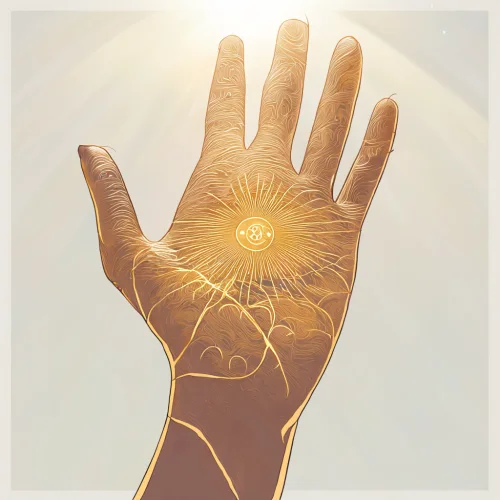
Have you ever glanced at your palm and wondered if those lines hold clues about your future—especially when it comes to wealth and success? You’re not alone. Across cultures, palms have long been observed as mirrors of character, potential, and life patterns. In Chinese palmistry, certain markings—like the so-called “wealth line” or “success triangle”—often spark curiosity and even hope. But before you search for a golden sign that guarantees prosperity, let’s take a grounded, thoughtful look at what these symbols actually represent—and what they don’t.
What Are “Wealth Lines” in Chinese Palmistry?
In Chinese palmistry, the term “wealth line” most commonly refers to a secondary line that runs parallel to the heart line—or sometimes diagonally upward from the base of the pinky finger toward the mount of Mercury (the fleshy area below the little finger). Unlike the major lines (life, head, heart), this marking is not present on everyone’s palm, and its appearance can change subtly over time. Traditionally, it’s associated with financial awareness, resourcefulness, and the ability to attract or manage material support—not necessarily sudden riches. Its clarity, length, and connection to other lines matter more than mere presence. A faint, broken, or interrupted line may suggest shifting priorities around money, while a strong, unbroken one often reflects consistency in values related to security and exchange.
The “Success Triangle”: Symbolism Over Certainty
You may have heard of the “success triangle”—a formation where three lines intersect to create a triangular shape near the base of the index or middle finger, often overlapping the mounts of Jupiter (ambition) and Saturn (discipline). In classical Chinese hand analysis, this configuration isn’t treated as a fortune-telling device. Instead, it’s viewed as a symbolic convergence: ambition meeting patience, vision meeting execution. Think of it less as a “ticket to success” and more as an indicator of inner alignment—when motivation, responsibility, and strategic thinking coexist in balance. Not everyone has a clearly defined triangle, and many people without it build fulfilling, impactful lives through steady growth and learning. Its value lies in prompting reflection: Where do I naturally bring together drive and diligence? Where might I strengthen that balance?
Why Palm Markings Aren’t Predictions—They’re Invitations
Chinese palmistry has deep roots in Daoist and Confucian thought—emphasizing harmony, self-cultivation, and responsiveness to change. From this perspective, the palm is not a static map but a dynamic record shaped by choices, habits, relationships, and environment. Lines may deepen with repeated action (like calluses from practice), fade with disuse, or shift in response to major life transitions. That means no single marking—including so-called wealth or success signs—functions as a fixed destiny. Rather, each feature invites gentle inquiry: What strengths do I already recognize in myself? Which qualities am I nurturing—or overlooking? This reflective approach turns palm reading from fortune-telling into a tool for mindful self-awareness.
Practical Ways to Engage With Your Palm—Thoughtfully
Instead of scanning your palm for “proof” of future success, try using it as a quiet prompt for personal reflection. Here are four grounded, respectful ways to begin:
- Observe without judgment. Spend two minutes looking at both palms—not searching for signs, but noticing texture, warmth, flexibility, and how your hands feel when relaxed versus engaged.
- Map your major lines gently. Trace your life, head, and heart lines—not to interpret them “correctly,” but to notice where they begin, cross, or end. Do any intersections stand out? What life experiences align with those areas chronologically?
- Notice changes over time. Take a neutral photo of your palms every few months. Compare—not to measure “progress,” but to witness how your hands respond to seasons of rest, learning, or activity.
- Pair observation with intention. If you see a clear line near the mount of Mercury, ask: How do I communicate value? If your fate line is faint or forked, consider: Where do I feel most guided—and where do I choose my own direction?
Ultimately, your palm holds no secret code for guaranteed wealth or success—but it does hold a quiet, accessible invitation: to pay closer attention to how you move through the world, how you relate to resources (time, energy, connection), and how you define fulfillment on your own terms. In Chinese tradition, true prosperity isn’t measured only in abundance—it’s found in balance, resilience, and the dignity of effort. So next time you glance at your hand, pause—not to decode fate, but to honor the living, evolving story already written in your skin, your choices, and your care.