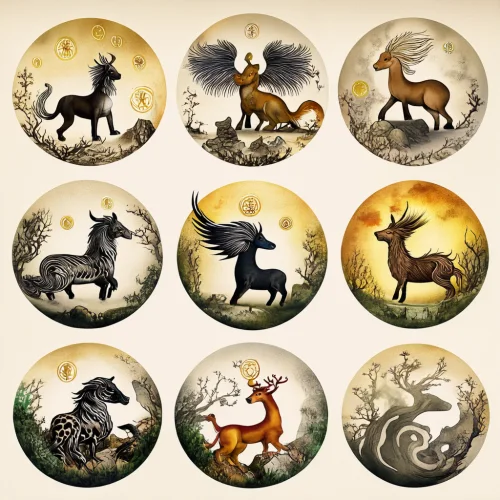
Have you ever wondered why the Chinese zodiac repeats every 12 years—while Western astrology cycles through 12 signs over a single year, and Vedic astrology uses a 60-year planetary cycle? It’s a common question for newcomers: Why twelve? Why these particular animals? And what does this rhythm actually mean—not as fortune-telling, but as a cultural and historical lens? Let’s explore the origins, logic, and living relevance of the 12-year cycle in a way that honors its roots while keeping things clear and grounded.
The Ancient Roots: Astronomy, Not Mythology
The 12-year cycle isn’t arbitrary—it reflects early Chinese astronomical observation. Ancient astronomers tracked Jupiter’s orbit around the Sun, which takes approximately 11.86 years—close enough to round to 12. They called Jupiter the “Year Star” (Suìxīng) and divided its path across the sky into 12 sections, each representing one year. This celestial framework became the backbone for timekeeping, agriculture, and record-keeping long before animal names were attached. So the number 12 comes first from the sky—not from folklore—and the animals were later added as memorable, culturally resonant symbols.
Why These Twelve Animals?
The choice of rat, ox, tiger, rabbit, dragon, snake, horse, goat, monkey, rooster, dog, and pig wasn’t random—or purely symbolic. Each animal was selected for practical, ecological, and behavioral relevance in ancient agrarian China:
- Rat: Highly adaptable, prolific, and active at night—fitting for the first position (the hour of midnight).
- Ox: Symbol of diligence and strength—essential for farming and stability.
- Tiger: Revered as a protector against evil spirits and disease, especially in folk medicine traditions.
- Rabbit: Associated with the moon and springtime renewal—gentle yet vital for balance.
- Dragon: The only mythical creature—representing power, auspiciousness, and natural forces like rain and rivers.
- Pig: Last in the cycle, linked to harvest, abundance, and completion—reflecting the end of the agricultural year.
No animal was chosen for “luck” alone. Each had real-world significance in daily life, seasonal rhythms, or communal values—making the zodiac a mnemonic tool as much as a spiritual one.
How the Cycle Fits Into Broader Chinese Timekeeping
The 12-year zodiac is just one layer of a more complex system. It interlocks with two others:
- The 10 Heavenly Stems (representing cosmic energies like yin/yang and the five elements), and
- The 12 Earthly Branches (linked to time divisions: hours, months, years, and directions).
When combined, the 10 stems and 12 branches create a 60-year cycle—the least common multiple of 10 and 12. That’s why 2024 is not just the Year of the Dragon, but the *Jiǎchén* year (Wood Dragon)—a unique pairing that repeats only once every 60 years. Think of the 12-animal cycle as the “face” of the system: familiar and accessible—while the full 60-year structure offers deeper nuance for those who study it closely.
What the 12-Year Rhythm Means Today
For modern readers, the 12-year cycle offers a gentle, human-scale way to reflect on time and identity—not as destiny, but as pattern recognition. If you were born in 1984, 1996, or 2008, you share a zodiac sign with people across generations. That doesn’t mean you’ll have identical lives—but it can invite thoughtful questions: How do family stories about “dragon years” shape expectations? What values or challenges tend to surface in your birth-year cohort? In classrooms, therapists’ offices, or intercultural workplaces, understanding these shared reference points builds empathy—not prediction.
Practical Tips for Engaging Thoughtfully With the Zodiac
You don’t need to believe in fate to find value in the zodiac. Try these grounded, respectful approaches:
- Learn the basics in context: Read about how the zodiac functioned historically—as part of almanacs, imperial exams, and village festivals—not as standalone horoscopes.
- Compare, don’t conflate: Notice how the Chinese zodiac emphasizes collective time and cyclical change, unlike Western sun-sign astrology’s focus on individual personality archetypes.
- Ask open questions: Instead of “What does my sign say about my future?” try “What qualities did people in my birth year admire—or worry about—in their elders?”
- Respect regional variation: Vietnam swaps the rabbit for the cat; Tibet includes the deer and crow. There’s no single “official” version—just evolving traditions.
Ultimately, the 12-year cycle endures because it’s both precise and poetic: rooted in observable astronomy, enriched by lived culture, and flexible enough to grow with each generation. It’s not about being trapped in repetition—it’s about recognizing rhythm, honoring continuity, and finding your place within a much older conversation about time, nature, and human experience.