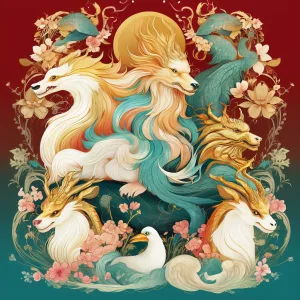
Have you ever met someone who proudly says, “I’m a Tiger” or “I was born in the Year of the Ox”—and wondered what that really means? You’re not alone. The Chinese zodiac is one of the world’s oldest and most enduring cultural systems—but it’s often misunderstood outside of Chinese-speaking communities. It’s not just a fun label or a party-trick horoscope. It’s a 2,000-year-old framework rooted in astronomy, agriculture, and philosophy—and it continues to shape celebrations, conversations, and even naming traditions across East Asia. In this article, we’ll explore what the Chinese zodiac actually is, where it comes from, how it works, and why it remains meaningful—not as fate, but as a shared language of reflection and connection.
A Cycle of Twelve, Not Twelve Signs
The Chinese zodiac isn’t a set of personality “types” assigned at birth like Western astrology. Instead, it’s a repeating 12-year cycle, with each year named after an animal: Rat, Ox, Tiger, Rabbit, Dragon, Snake, Horse, Goat, Monkey, Rooster, Dog, and Pig. Your zodiac animal is determined by the lunar year you were born in—not your birth month or day. For example, someone born on February 1, 2024 is a Dragon (since the Lunar New Year began on February 10, 2024), while someone born on January 25, 2024 is still a Rabbit. This distinction matters: the zodiac follows the traditional lunisolar calendar, which aligns with moon phases and seasonal markers—not the Gregorian calendar used internationally.
More Than Myth: Origins in Observation and Culture
The zodiac’s origins trace back over two millennia—to the Han Dynasty (206 BCE–220 CE)—but its roots go even deeper, into ancient Chinese timekeeping and agrarian life. Early astronomers tracked Jupiter’s 12-year orbit around the sun and matched it to earthly cycles. Animals were chosen not randomly, but for their symbolic resonance: the Ox represents diligence and reliability; the Rabbit, gentleness and caution; the Dragon, vitality and auspicious energy (note: the Chinese dragon is a benevolent, celestial symbol—not a fire-breathing monster). These associations grew through folklore, poetry, and imperial records—not mystical decree, but collective cultural interpretation over centuries.
How People Use the Zodiac Today
In modern China and many diasporic communities, the zodiac functions more like a cultural shorthand than a predictive tool. You’ll see it in everyday contexts:
- Family conversations: Elders may refer to a child’s zodiac animal when commenting on temperament (“Ah, a Monkey—always curious and quick!”), gently framing behavior without labeling it as fixed or limiting.
- Festive tradition: Each Lunar New Year features decorations, red envelopes, and greetings themed around the incoming animal—reinforcing continuity and shared identity.
- Life milestones: Some families consider zodiac compatibility when planning weddings or naming babies—but rarely as a sole deciding factor. It’s one thread among many, including family values, education, and personal choice.
- Popular media: TV dramas, comics, and social media posts often use zodiac themes for humor or relatability—“Rabbit energy” might describe someone calm under pressure, while “Dragon energy” evokes bold initiative.
Importantly, most people don’t consult their zodiac before making decisions—they use it to reflect, connect, or add warmth to conversation. Think of it less like checking the weather forecast and more like sharing a favorite season: it gives context, not control.
What the Zodiac Doesn’t Do (And Why That Matters)
It’s helpful to clarify what the Chinese zodiac is *not*:
- It’s not fortune-telling. There’s no authoritative “zodiac prediction” for your job, relationship, or health—nor do traditional texts claim such power.
- It doesn’t override individuality. Two people born in the Year of the Dragon share an animal sign—but their personalities, choices, and experiences are shaped by countless factors: upbringing, education, values, and lived reality.
- It’s not static or absolute. The zodiac is part of a larger system—including the Five Elements (Wood, Fire, Earth, Metal, Water) and Yin-Yang balance—that adds nuance. A “Wood Dragon” (born in 1964 or 2024) carries different qualities than a “Earth Dragon” (1928 or 1988).
This layered approach invites curiosity, not certainty. When someone says, “I’m a Goat,” they’re often signaling openness, creativity, or sensitivity—not declaring destiny. Recognizing that distinction helps us engage respectfully—with humility toward cultural depth, and realism about human complexity.
Getting Started With Respect and Clarity
If you’d like to learn your own zodiac animal—or understand a friend’s—you can look up your birth year against a reliable lunar calendar converter (many free tools exist online). Keep these practical tips in mind:
- Double-check the Lunar New Year date. Since it falls between January 21 and February 20, your Gregorian birth date alone won’t tell the full story.
- Pair it with context. Read about your animal’s traditional traits—but also explore how those symbols appear in art, festivals, or proverbs. That deepens understanding beyond surface labels.
- Ask questions, not assumptions. If someone shares their zodiac, respond with interest—not judgment. “What does being a Snake mean to you?” opens space for personal meaning.
- Notice the rhythm—not the rule. The 12-year cycle mirrors natural patterns: growth, rest, renewal. That cyclical thinking itself offers gentle perspective—especially in fast-paced, linear-minded societies.
Ultimately, the Chinese zodiac endures because it reflects something universal: our desire to find patterns, share stories, and locate ourselves within time and tradition. It’s not about predicting your path—but about honoring the quiet ways culture shapes how we see ourselves and others. Whether you’re a curious newcomer or a lifelong observer, approaching it with openness—not expectation—is the most authentic way to begin.