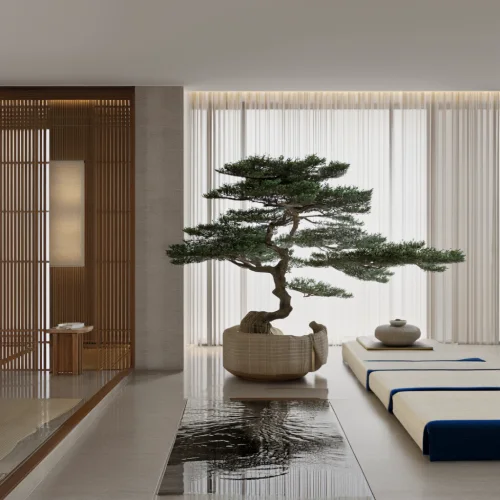
Feng Shui is often introduced through images of perfectly aligned sofas, bamboo fountains in living rooms, or compasses held over floor plans—but that’s only the surface. While interior arrangement is a familiar entry point, Feng Shui is fundamentally a practice of mindful relationship: how we move through and inhabit space, time, and intention. It asks not just “Where should this chair go?” but “How does this space support clarity, rest, connection—or hinder them?” This article explores where Feng Shui applies beyond the living room—and how its principles remain adaptable, grounded, and quietly powerful across many dimensions of daily life.
More Than Walls: Feng Shui in Outdoor Spaces
Gardens, balconies, courtyards, and even window sills are active participants in Feng Shui—not as decorative afterthoughts, but as extensions of your personal energy field. In classical practice, outdoor areas are seen as “the mouth of qi,” where vital energy enters your environment. A cluttered balcony with broken pots or overgrown vines may slow or scatter incoming qi, while a clean, gently flowing water feature (even a small tabletop fountain) can invite calm momentum. Consider sightlines: a clear view from your front door to the horizon supports openness and opportunity; dense shrubbery blocking that line invites stagnation—not because shrubs are “bad,” but because they interrupt flow. Practical tip: Start small. Clear one corner of your patio, add a potted plant with rounded leaves (like peace lily or jade), and notice how it feels to sit there for five minutes each morning.
Workspaces—From Desk to District
Your desk isn’t neutral real estate. It’s where decisions form, relationships unfold, and attention either sharpens or frays. In office Feng Shui, the “command position” matters most: sit so you can see the door without being directly in its line of flow—this supports awareness and ease. Avoid sitting with your back to entrances or large windows (which can create subtle unease). But Feng Shui doesn’t stop at your chair. It extends to team layouts, meeting room orientation, and even how departments are distributed across floors. Some architects and urban planners integrate Feng Shui concepts—like balancing open plazas with sheltered walkways—to encourage both movement and pause. You don’t need to redesign your office building to apply this: try adjusting your monitor height for relaxed posture, adding soft light near task areas, or placing a small mirror to expand your visual field behind you.
Cities, Campuses, and Community Spaces
Yes—Feng Shui has long informed city planning, especially in East Asian traditions. Ancient capitals like Beijing and Kyoto were laid out with mountains as “back support,” rivers as “wealth channels,” and central axes aligned to honor harmony between human activity and natural systems. Today, landscape architects sometimes consult Feng Shui principles when designing parks, university campuses, or housing developments—not to predict fortune, but to prioritize walkability, visual coherence, access to nature, and transitional zones between public and private realms. For example, a well-placed canopy tree near an apartment entrance offers shade, softens hard edges, and creates psychological “shelter”—a concept echoed in both Feng Shui and environmental psychology. As a resident or visitor, you can observe how a neighborhood feels: Are streets intuitive to navigate? Do public benches face gathering spaces or blank walls? These details shape collective comfort—and that’s part of Feng Shui’s scope.
Time, Rhythm, and Personal Space Rituals
Feng Shui also engages with time—not as rigid “lucky dates,” but as respectful attunement to natural and personal cycles. The Chinese solar term calendar marks shifts in light, temperature, and energy flow; some people adjust seasonal routines accordingly—lighter meals in spring, deeper rest in winter, gentle decluttering before the Lunar New Year. Similarly, daily rhythms matter: opening curtains at sunrise helps regulate circadian rhythm (a modern health insight that aligns with Feng Shui’s emphasis on light and vitality). Even digital habits fit here. Setting boundaries around screen time—especially before bed—supports mental stillness, much like clearing a nightstand of devices to make space for rest. Consider these simple, time-aware practices:
- Open windows for 5 minutes each morning to refresh indoor air and invite daylight
- Rotate artwork or objects seasonally—not for symbolism alone, but to reflect your evolving focus and keep your environment feeling responsive
- Pause before entering a new space (a meeting room, a friend’s home, even your own kitchen) and take one conscious breath—this brief grounding echoes the Feng Shui idea of “arriving fully”
- Keep a small journal to note how changes in your surroundings affect your mood or focus—not to prove cause-and-effect, but to build self-awareness
What Feng Shui Is Not—and Why That Matters
Feng Shui is not a set of universal rules requiring identical outcomes for everyone. It does not promise wealth, romance, or success. It’s not about buying “cures” or placing objects based solely on color or number superstition. At its best, it’s a reflective, iterative practice—one that invites observation, curiosity, and kindness toward yourself and your surroundings. Its value lies less in perfection and more in presence: noticing how light falls across your desk at 3 p.m., whether your front path feels welcoming or rushed, or how your bedroom supports (or disrupts) rest. You don’t need a compass or a consultant to begin. You only need willingness to ask, gently: “Does this space serve what matters to me right now?”
So is Feng Shui only about home design? No—it’s about relationship: to place, to time, to others, and to yourself. Whether you’re arranging a bookshelf, choosing a café table, walking a new neighborhood, or simply pausing to feel the breeze on your skin, you’re already practicing spatial awareness—the quiet heart of Feng Shui.